Dwarf Galaxies and Dark Matter
Ultra-diffuse galaxies (UDGs) — extremely low-surface-brightness galaxies with sizes comparable to the Milky Way but stellar masses typical of dwarf galaxies — offer unique laboratories for studying dark matter. Their globular cluster (GC) populations carry rich information about the host dark-matter halo, providing an avenue to constrain the dark-matter distribution using photometric data alone. We explore this connection in the following project.
Constraining Dark Matter with Globular-Cluster Mass Segregation: NGC5846-UDG1
Liang, J., Jiang, F., Danieli, S., Benson, A., & Hopkins, P. (2024), The Astrophysical Journal, 963, 76. [ADS] [arXiv]
Motivation
The ultra-diffuse galaxy NGC5846-UDG1 hosts ~50 globular clusters for a stellar mass of only \(\sim 10^8\,M_\odot\). Applying the empirical GC-abundance–halo-mass relation yields an overly massive halo of \(\sim 10^{11}\,M_\odot\). However, the GC population exhibits striking radial mass segregation — more massive GCs lie closer to the galaxy centre — a hallmark of dynamical friction. Since dynamical friction depends on the GC-to-host mass ratio \(m/M\), significant mass segregation requires that the host halo cannot be orders of magnitude more massive than the stellar component, pointing to a much lower halo mass. To resolve this tension, we develop a semi-analytical model of GC evolution and use MCMC to constrain the dark-matter halo using imaging data alone.
Semi-Analytical Model of GC Evolution
Each GC orbits in a composite host potential (dark matter + stars) under the influence of Chandrasekhar dynamical friction:
\[ \mathbf{a}_{\mathrm{DF}} = -4\pi G^2 m \sum_i \ln\Lambda_i\,\rho_i(r)\,\frac{F(<V_i)}{V_i^3}\,\mathbf{V}_i \]We adopt the physically-motivated Coulomb logarithm of Petts et al. (2015), which naturally captures the core-stalling effect in cored halos and avoids the overestimated orbital decay from the simplistic \(\ln(M/m)\) prescription widely used for satellite galaxies.
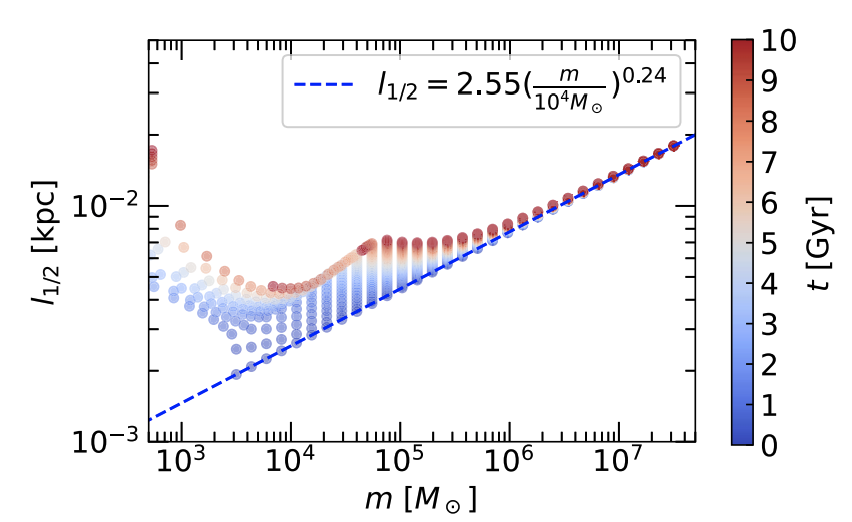
Over 10 Gyr, GCs evolve in mass and structure under tidal stripping and two-body relaxation. We derive a unified structural evolution equation that couples both processes:
\[ \frac{\mathrm{d}\rho_{1/2}}{\rho_{1/2}} = \left[\alpha\!\left(5 - \frac{3}{f_t}\right)\frac{\xi_t}{\tau_{\mathrm{dyn}}} + \left(5 - \frac{3}{f_r}\right)\frac{\xi_e}{\tau_r}\right]\mathrm{d}t \]where \(\xi_t\) and \(\xi_e\) are the mass fractions beyond the tidal radius and above the escape velocity, \(\tau_{\mathrm{dyn}}\) and \(\tau_r\) are the host dynamical and internal relaxation timescales, and the coupling parameters \(f_t\) and \(f_r\) are calibrated against N-body tidal tracks and Hénon's classical result, respectively. The evolution is strongly mass-dependent: low-mass clusters (\(m \lesssim 10^{4.5}\,M_\odot\)) expand and dissolve, intermediate-mass clusters expand modestly, and massive clusters (\(m \gtrsim 10^6\,M_\odot\)) remain largely intact — naturally producing the observed GC mass function peaked at \(\sim 10^5\,M_\odot\). Full derivations of all model components are given in the paper (Sections 2.1–2.3).
The mass-size evolution is strongly mass-dependent, as illustrated below. The most massive clusters (\(m \gtrsim 10^6\,M_\odot\)) barely evolve in mass or size over 10 Gyr. Intermediate-mass clusters (\(m \approx 10^{5\text{–}6}\,M_\odot\)) primarily expand due to two-body relaxation, with marginal mass loss. Low-mass clusters (\(m \lesssim 10^{4.5}\,M_\odot\)) expand rapidly until tidal truncation takes effect, leading to quick mass loss and eventual dissolution. These mass-dependent behaviours work together to shape the evolved GC mass function — peaked at \(m \sim 10^5\,M_\odot\) — and ensure that mass segregation arises naturally, since massive GCs remain intact and always experience the strongest dynamical friction.
Main Results
1. UDG1 inhabits a low-mass, low-concentration halo
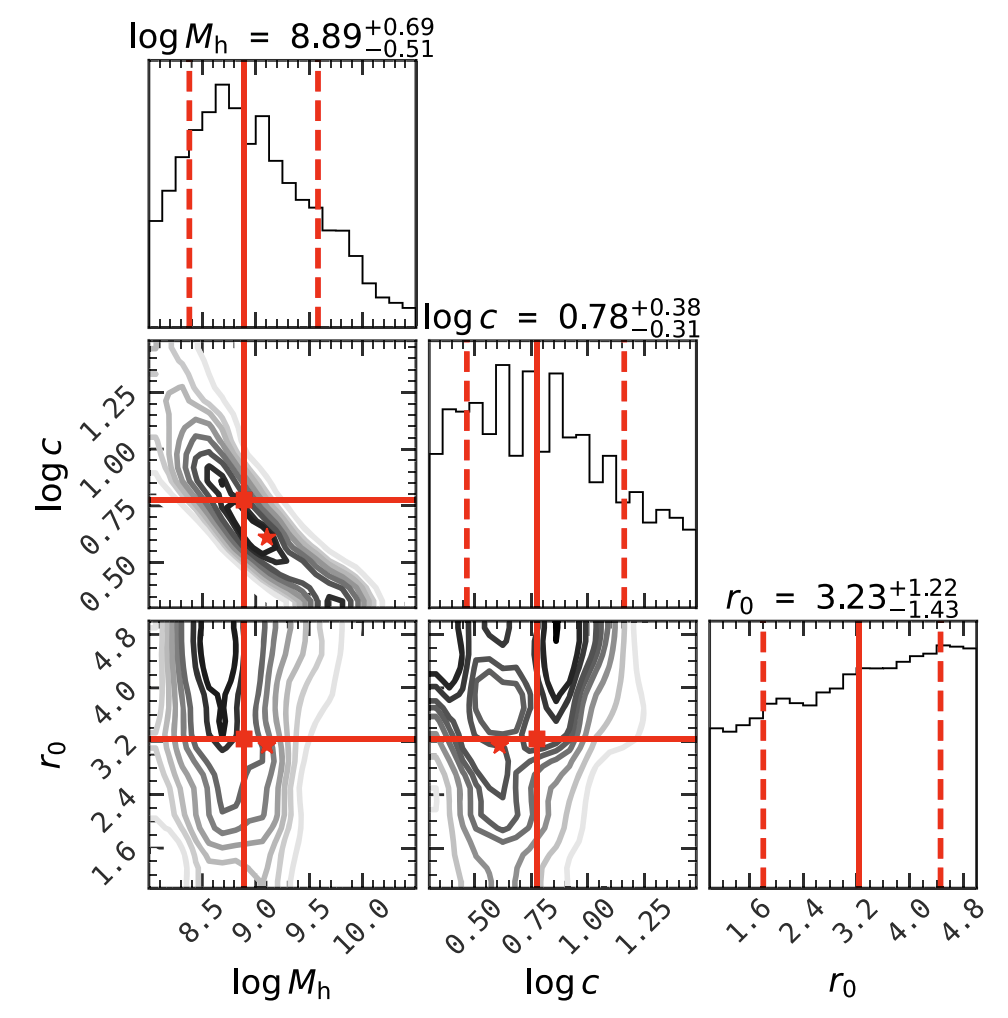
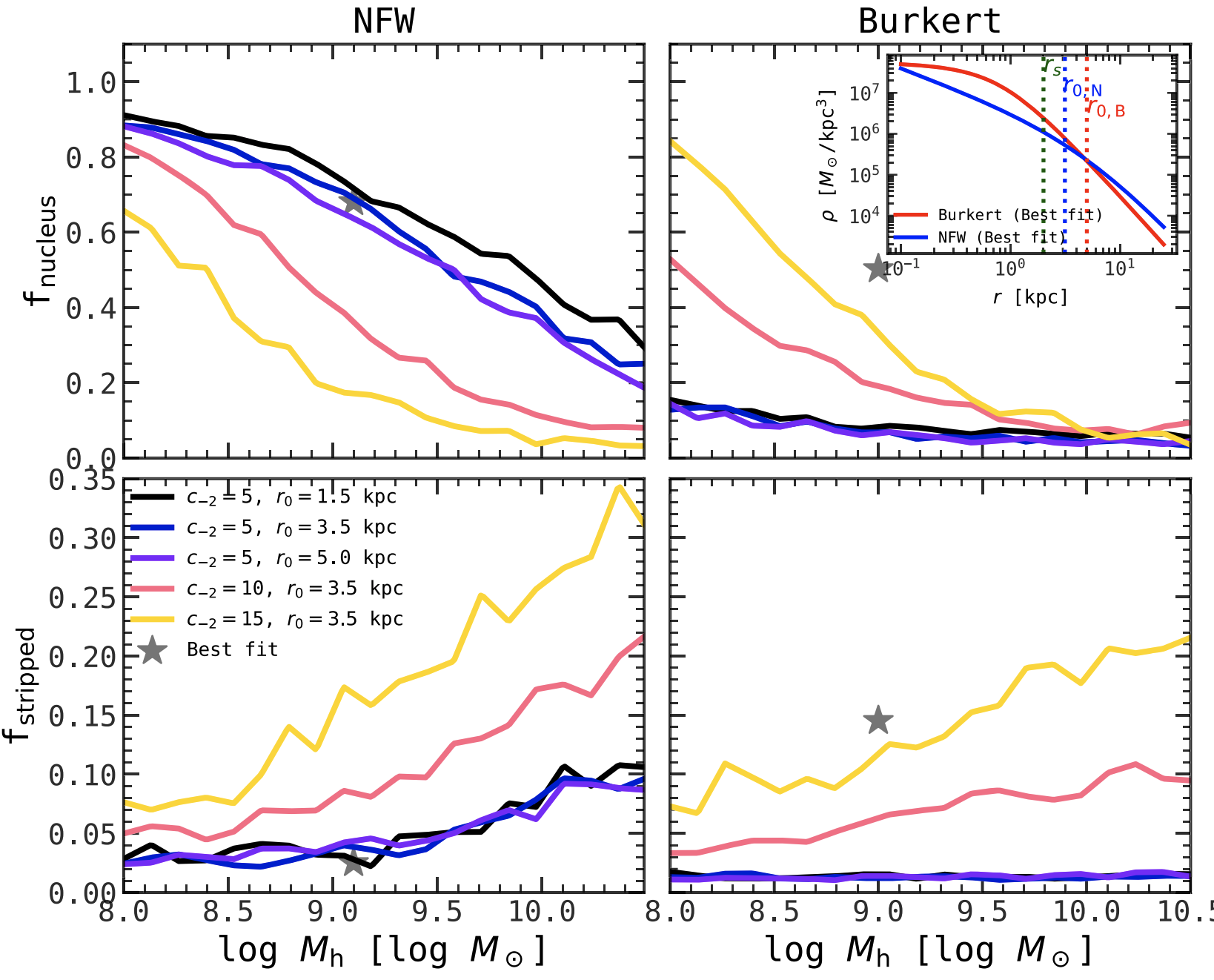
Using MCMC with both NFW (cuspy) and Burkert (cored) halo profiles, we find posterior-mode halo masses of \(M_h \approx 10^{9.1}\,M_\odot\) (NFW) and \(10^{9.0}\,M_\odot\) (Burkert), with concentrations well below the cosmological average. This places UDG1 firmly in the dark-matter-poor regime (\(M_\star/M_h \sim 0.1\)), consistent with the theoretical picture that UDGs form in low-concentration halos puffed up by supernovae feedback.
2. The model reproduces the observed GC statistics
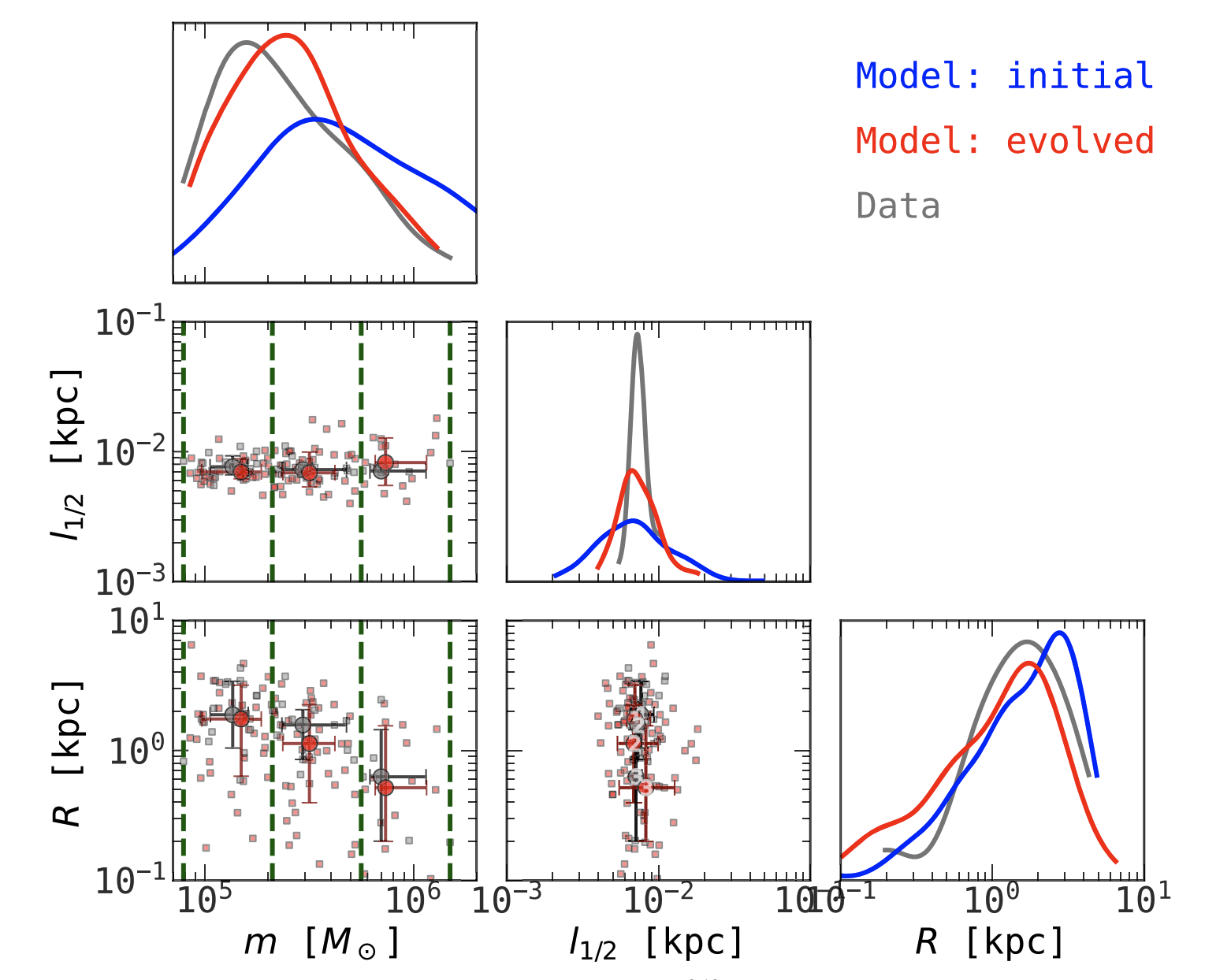
Model realizations with the best-fit parameters simultaneously reproduce the observed radial mass segregation, GC mass function, size distribution, and size-mass relation.
3. UDG1 is an outlier to galaxy–halo scaling relations
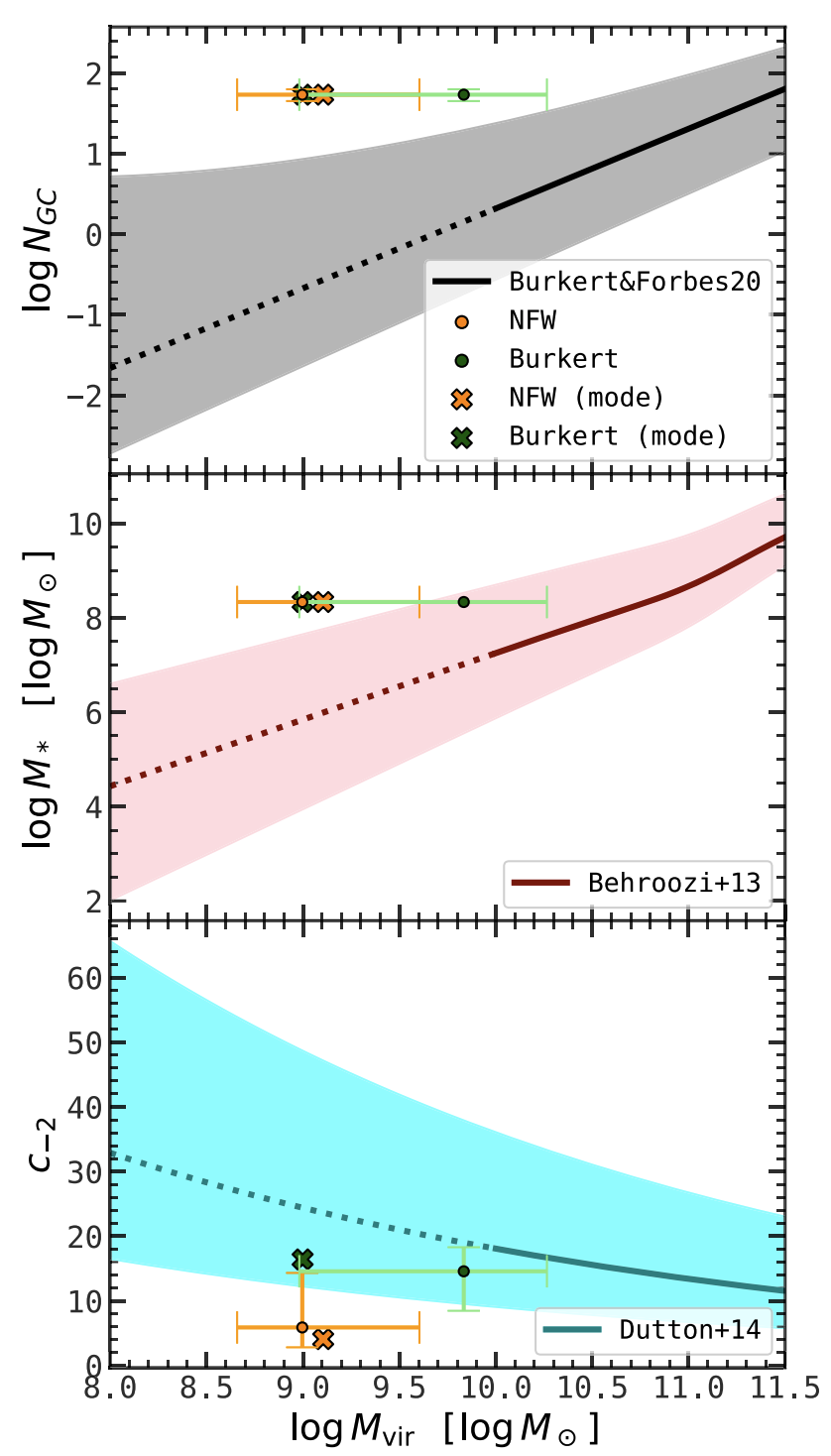
UDG1 deviates by \(\sim 2\text{–}3\sigma\) from the GC-abundance–halo-mass relation, the stellar-mass–halo-mass relation, and the concentration–mass relation. This warns against naively using the GC-abundance relation to estimate halo masses for UDGs, and supports the flattening of this relation at the low-mass end.
4. Cuspy vs. cored halos: implications for nuclear star clusters
The most striking difference between cuspy and cored profiles is in nuclear star cluster (NSC) formation. In cuspy NFW halos with \(M_h \lesssim 10^{9.5}\,M_\odot\), massive GCs sink to the centre and coalesce into an NSC. In cored halos, core-stalling prevents this. Since UDG1 is non-nucleated, our results favour a cored, low-mass halo — consistent with core formation via supernovae-driven potential fluctuations. The model also predicts lower GC velocity dispersions than the smooth stellar background due to dynamical friction, in agreement with available kinematic measurements (Müller et al. 2020; Forbes et al. 2021). Further details on the velocity dispersion profiles, orbital eccentricities, stripped fractions, and comparison with previous models are presented in the paper (Section 4).
Summary
We have demonstrated that radial mass segregation of globular clusters can constrain the dark-matter distribution of UDGs using photometric data alone. NGC5846-UDG1 inhabits a low-mass (\(M_h \sim 10^9\,M_\odot\)), low-concentration halo, and is an outlier to multiple galaxy–halo scaling relations. The distinction between cuspy and cored halos manifests most clearly in NSC formation, suggesting non-nucleated UDGs preferentially inhabit cored halos. Our model is publicly available at https://github.com/JiangFangzhou/GCevo.